

Exegol on $50M a mission
Anyone working in offensive cybersecurity knows that having the right toolkit is essential for being efficient. But with the ever-growing number of tools, programming languages, and installation methods, our environments keep getting heavier and harder to maintain. Whether you prefer bare metal installs, virtual machines, cloud instances, or containers, each option comes with its own challenges. Numerous distributions exist, each offering different toolsets and philosophies.
But no matter what we choose, the reality is that we spend far too much time configuring, installing, maintaining, and customizing these environments. We should be spending this time on hacking, not troubleshooting. Instead of focusing on our core job, we end up becoming part-time sysadmins for our own setups, and sometimes for our teams as well.
Exegol was born from that. As a way to save time, be more productive, more efficient, and really keep that promise instead of making it a punchline.
This article comes nearly six years after Exegol began and takes a straightforward look at whether we've delivered on one of our original promises: saving offensive security professionals' time.
Where do we lose time?
Installation and update hassles
We all waste too much time just getting our tools installed and up to date. There are so many different ways to install things: package managers, cloning Git repos, downloading binaries, or compiling by hand. Tools get updated often, so we're constantly re-installing, reading instructions that might be out of date, and running into new errors. When something doesn't work after an update, you spend hours researching why, applying temporary patches, or finding workarounds. If documentation is missing or confusing, we end up searching forums and random blog posts for help.
Dependency hell
When you install several tools, their dependencies can end up in conflict. Maybe you need a specific version of Python for one tool, and a different version for another. Modern Python, for example, insists on using virtual environments to prevent breaking system packages. This is helpful, but it also means spending extra time creating, activating, and managing those environments for each project. The same headache exists with Ruby, Rust, Go, or other languages that have their own environment managers. Sometimes you have to compile tools from source, which requires tracking down even more dependencies and handling strange errors that depend on your operating system. All of this troubleshooting often takes longer than actually using the tool.
Learning new tools and environments
Every time you need to use a tool written in a language you're not familiar with, or work with a new environment, there's a learning curve. You have to figure out how Go modules work, understand Ruby's gem system, learn Rust's cargo, or get comfortable with whatever ecosystem the tool uses. This isn't just about installation. It's about understanding the tool's ecosystem well enough to troubleshoot when things go wrong.
Team misalignment and repeating setups
In a team, everyone can end up with different versions installed, which leads to confusion and "it works on my machine" moments. Setting up the same environment on multiple machines means repeating configs, working around hardware differences, and troubleshooting again and again. When you change machines, switch companies, or need to reinstall, you're starting from scratch: recreating all your configurations, reinstalling tools, and rebuilding your workflow. People using virtual machines have to manage and revert snapshots, which takes even more time. If you mess up a snapshot, you might even lose data.
Environments slowly breaking down
Over time, your setup gets messy. You collect unused dependencies, settings change, and things get less stable. On bare metal, you might eventually wipe everything and start over. If you use containers, you have to understand Docker commands and configuration files, which involves its own learning curve. If your distro is missing certain tools or configs, you end up writing your own scripts or playbooks, which adds more work. And when you make a mistake (maybe you accidentally delete something important or break a critical configuration), you're looking at a full reinstall or rollback, which can take hours.
Managing assets and unexpected breakdowns
You also spend time finding, downloading, and organizing wordlists, scripts, and other resources. But where are they? Without centralized documentation or organization, you're constantly searching for that wordlist you downloaded last month, or trying to remember where you put those custom rules. Sometimes, a tool update breaks your setup right in the middle of an engagement, forcing you to stop and fix things quickly. When a command doesn't work during an audit, you waste precious time searching for an equivalent alternative instead of making progress. Virtual machines can take forever to boot or randomly fail when the hypervisor has issues, which interrupts your work.
Manual logging and documentation overhead
Most of us manually log our actions and commands, which is time-consuming and error-prone. You're copying commands into a document, trying to remember when you ran them, and manually adding timestamps. When you need to reference past commands, you're scrolling through pages of notes or searching through terminal history. And if you've hardcoded credentials in your history or logs, you're spending extra time finding and replacing them before sharing anything. Screenshots may need editing to blur sensitive information, adding another layer of manual work.
End-of-mission cleanup
After an engagement, you need to clean up all the data, scripts, and artifacts you've created. This isn't just about deleting files. It's about ensuring nothing sensitive remains, and organizing what needs to be kept. Without proper workspace organization, this becomes a tedious hunt through scattered directories and files.
Upgrade anxiety and sysadmin chores
After enough breakages, you start worrying that any upgrade might break your setup. Most of us have a horror story about running apt upgrade. For teams, someone always ends up maintaining the shared infrastructure, doing sysadmin chores instead of offensive security work.

Have we solved those issues?
We've tackled most of these pain points head-on. Here's how:
Pre-configured Docker images with ready-to-use and unit-tested tools, eliminating manual installations, compilation, dependency resolutions, and troubleshooting. Exegol users have outsourced this issue to us, the Exegol maintainers, and we like that deal. Our images come with hundreds of tools pre-installed, tested and configured, ready to go. No more researching why something doesn't work or applying temporary patches: we handle that.
Tools installed in isolated virtual environments by default, following our installation standards ensuring dependencies remain clean and never conflict. This means you can install, update or use tools without worrying about overwriting something else or breaking your environment. The right version for every tool, automatically and reliably.
Containers that mean way less overhead than VMs, with a wrapper to avoid the complexity of using containers. Easy, fast, and dedicated environments. No more hypervisor headaches or snapshot management nightmares. When you make a mistake or need a new environment, just spin up a fresh container in seconds.
Customization options that let users integrate their own tools and configurations right at container creation. Proving useful when switching machines, among other things.
Seamless cross-platform compatibility, ensuring your infosec toolbox fits smoothly with your operating system. Whether it is Linux, macOS, or Windows, Exegol installs on your platform of choice without cluttering your system. Everything stays tidy, and you get the same powerful experience everywhere.
Pre-loaded offline resources like wordlists, dictionaries, and scripts, all centralized in
/opt/resources. Our resources system ensures you have what you need, when you need it, without hunting through GitHub repos or outdated forums. No more wondering where that wordlist went.Built-in command history with context, featuring hundreds of pre-loaded commands with examples. Instead of searching for syntax and parameters every time, you can use Ctrl+R to browse through working examples.
Credential management with Exegol-history (aliased as
exh), avoiding hardcoded credentials in your history commands. Credentials are stored securely and accessed via environment variables, so when you need to share logs or reports, there's no manual find-and-replace needed. This also saves a lot of time, allowing you to run commands without editing the username/password/domain everytime.Workspace-based organization with persistent, dedicated folders per container. Each engagement gets its own workspace that persists even after container deletion. No more scattered files across your system. Everything for a mission is organized in one place, making end-of-mission cleanup straightforward and secure.
Shell logging with timestamps and timezone information. Your terminal sessions can be recorded if you enable it, so you know exactly what commands were executed, when they were, and what output they produced.
Mid-engagement breakdowns happen way less often, if at all anymore. And on the rare occasion they do, spinning up a brand new environment takes seconds. No more scrambling to fix a broken setup while a client waits.
The bottom line? We've shifted the burden of environment management from you to us. We build, so you can hack.
How many people did we solve this for?
Here’s a snapshot of our community and ecosystem impact as of this writing:
- 360,000+ DockerHub pulls
- 140,000+ PyPI installs (since April 2022)
- 3,000+ Discord members (community launched in October 2022)
- 3,000+ LinkedIn group members (launched February 2025)
- 50+ GitHub contributors, with around 10 considered "active"
As an infosec company, privacy is important to us, so we intentionally avoid extensive user tracking. This means we have limited direct data to measure our reach.
Considering the 1% rule or the 90-9-1 rule, we can estimate our user base to roughly 20,000-30,000 people. These numbers are approximations based on observable signals and community engagement.
How much time have we saved?
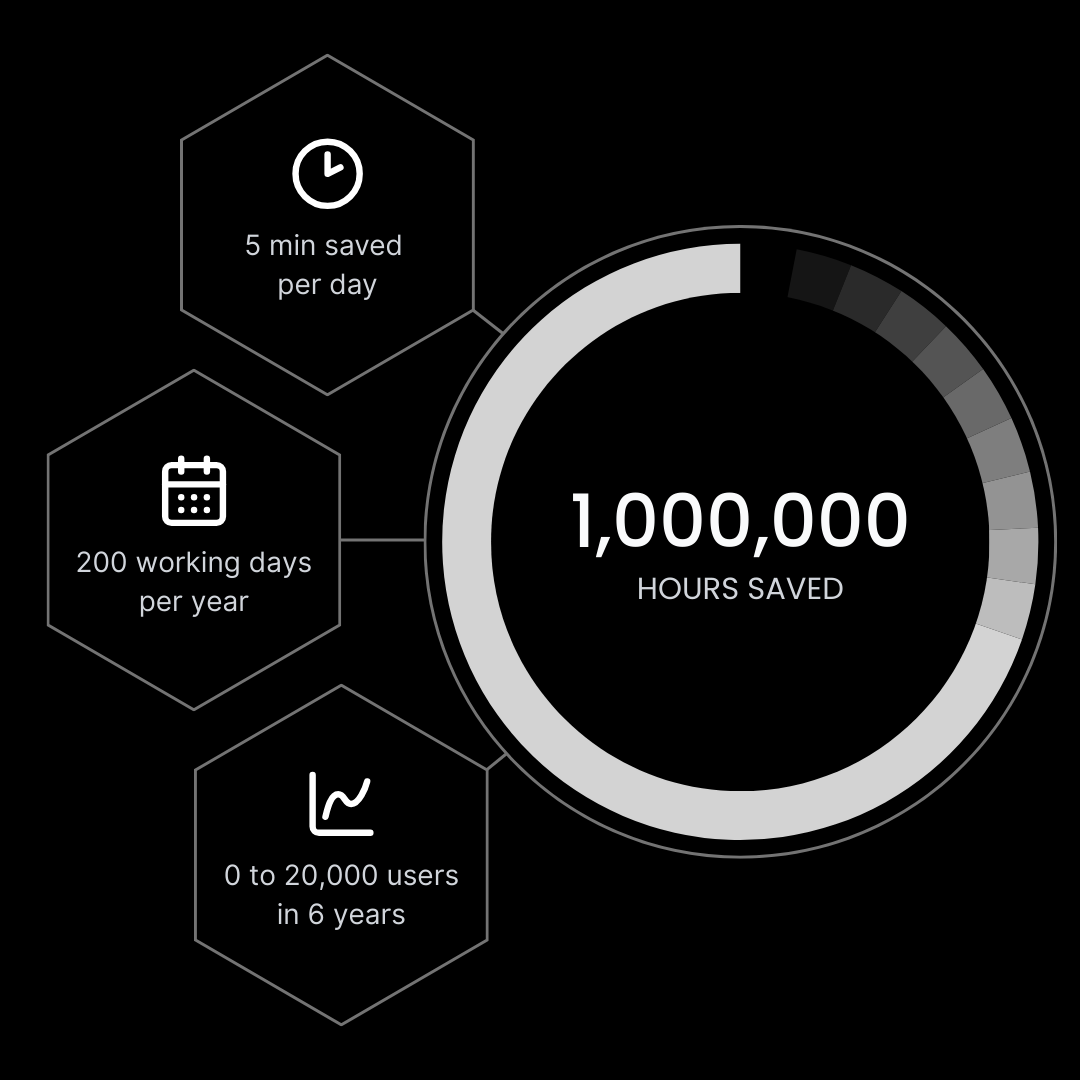
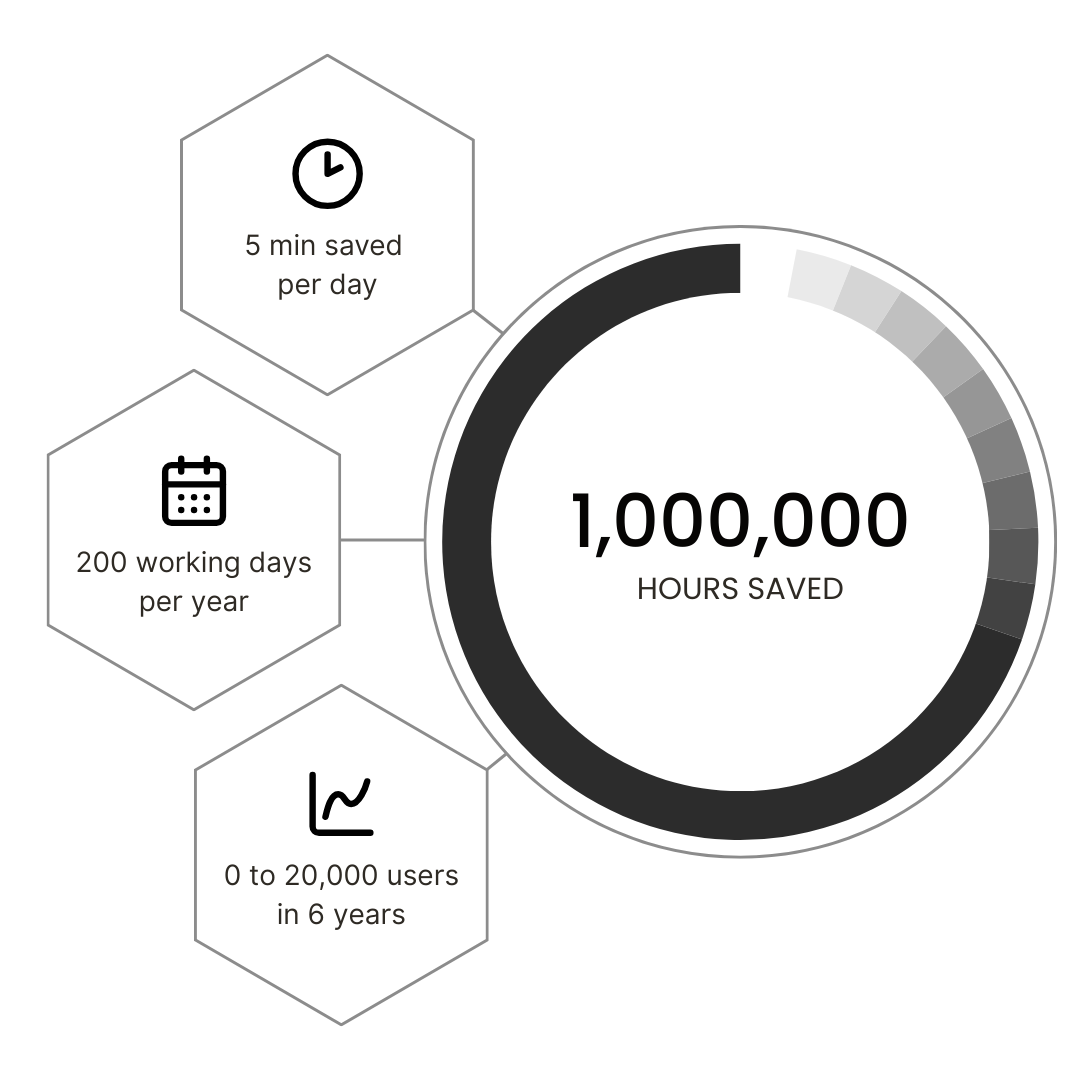
Let's do some math. Say the solutions Exegol implements saves its users 5 minutes per work day, 200 days per year. That's 1,000 minutes (or about 16.67 hours) saved per user annually. Actual savings are likely higher than this conservative estimate, but without measured data supporting it let's use this baseline for illustration.
Say we started with 1 user in 2020, and ended up with 20k by the end of 2025.
If we assume that the growth has been linear (which is how we felt it, but there's no actual data supporting that), it's a total of 1M hours. If we assume it was an exponential growth, it's a total of 200k hours.
The calculations:
For linear growth, we assume the user base increases steadily from 1 to 20,000, so the number of users at time
The cumulative user-years is the integral from 0 to 6:
Multiplying by 1,000 minutes per user-year and dividing by 60 yields approximately 1,000,050 hours saved (or 1M hours).
For exponential growth, we assume
Multiplying by 1,000 minutes per user-year and dividing by 60 yields approximately 201,939 hours saved (or 200k hours).
Linear growth results in more total savings due to a higher average user count over time compared to exponential growth, which concentrates users toward the end. Reality probably sits somewhere in between, but either way, the numbers are significant.
Time is money
Say average salary for Europe for offensive cybersecurity experts is $60k (~50k€) and $100k in the US (some data suggest higher average salary but let's be conservative).
Employer overheads (taxes, social contributions, benefits) add 40 to 50% in the US and 40-60% in Europe (varying by country). Applying a conservative blended 45% overhead gives an average annual employer cost of $98,600. Dividing by 2,080 work hours results in an hourly employer cost of approximately $47.
To account for opportunity cost (revenue potential from billable work), penetration testing services bill at $100-$400/hour in the US and €140-€250/hour (~$164-$292 USD) in Europe. Not all roles are fully billable, so we conservatively add a partial factor, adjusting the effective hourly value to $50. This reflects saved time enabling productive or revenue-generating activities without overstatement.
Using this $50/hour value, money saved totals to $50 million in the linear growth model and $10 million in the exponential growth model.
These conservative figures represent total economic value saved across users over six years, heavily weighted toward Europe given our user distribution, incorporating direct costs and modest productivity gains. The exponential model remains lower due to growth concentration in later years.
Conclusion
Six years ago, Exegol started as a simple answer to a frustrating problem: too much time spent managing environments, not enough time hacking. Today, the numbers tell a story we're proud of.
Whether it's 200k hours or 1M hours saved, whether it's $10M or $50M in economic value, the message is the same: we're going in the right direction. We've saved time. We've let our users focus on what they actually want to do. We've sometimes spent hours fixing a 5 seconds lag. We know why now.
Seeing these numbers is both validating and energizing. They reinforce our commitment and, we hope, will inspire further belief in Exegol’s mission.
— Charlie, Co-founder and CEO